

Walking into a bank or logging onto a financial app only to realize you are missing a crucial piece of paperwork is a frustrating experience. You might have your deposit money ready, but without the correct forms of identification, your application will come to an abrupt halt.
Financial institutions operate under strict federal guidelines that dictate exactly who they can do business with. These regulations require banks and credit unions to verify your identity, your residence, and your tax status before they can safely hold your money. Gathering these materials beforehand saves you time and ensures you can access your new account immediately.
This guide outlines exactly what paperwork you should prepare before applying for a new checking or savings account. We cover everything from standard personal banking needs to the complex documentation required for businesses, estates, and institutional entities.
By the time you finish reading, you will know exactly what to put in your folder before you sit down with a banker or start an online application.
Standard Personal Identification Requirements
The most important step in establishing a financial relationship is proving you are exactly who you say you are. Banks typically require at least two forms of identification to open a standard everyday checking or savings account.
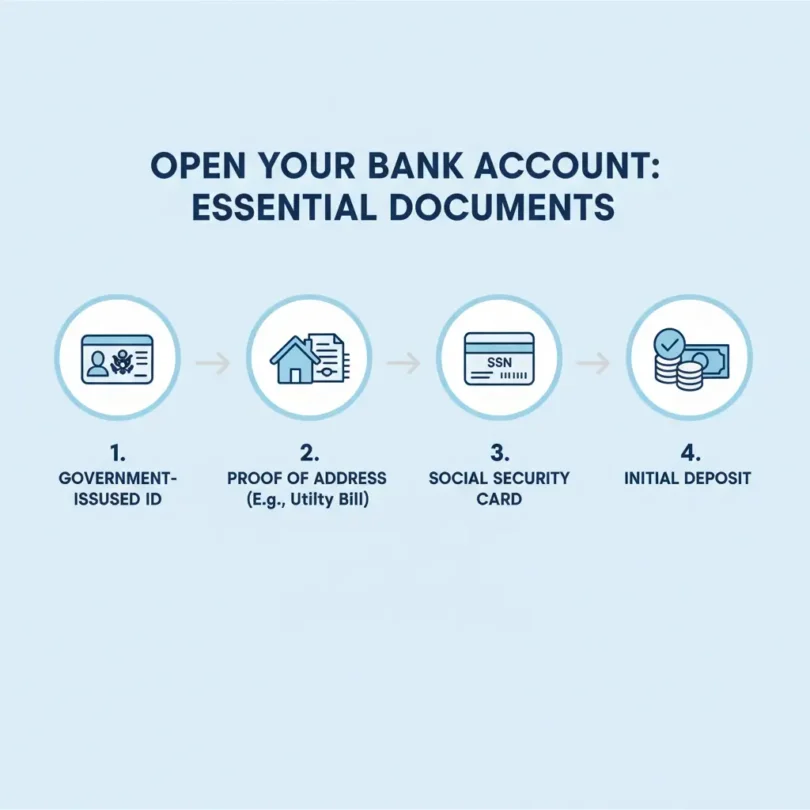
Your primary form of identification must be a government-issued document that includes your photograph. The most common acceptable documents include a valid, unexpired state driver’s license, a state-issued non-driver ID card, or a U.S. passport. If you are not a United States citizen, banks often accept a permanent resident card (Green Card) or a foreign passport.
Because forms of primary identification can sometimes be forged or stolen, financial institutions also ask for a secondary form of identification. This secondary document backs up your primary ID. Acceptable secondary forms of identification frequently include a birth certificate, a major credit or debit card issued by another bank, an employer identification badge, or a student ID card.
Always check with your specific bank before applying. While major institutions like Chase or Wells Fargo have highly standardized lists, local credit unions might have slightly different internal policies regarding what qualifies as a secondary ID.
Verification of Residency
Proving your identity is only the first half of the personal verification process. You also need to prove your physical address. Banks need to know where you live to send official correspondence, issue debit cards, and comply with state and federal banking laws. P.O. boxes are generally not accepted as a primary physical residence, though you can often use them as a separate mailing address once the account is established.
To prove your residency, you must provide official documents that show your full name and your current residential address. The document must be recent, typically dated within the last 30 to 60 days.
A utility bill for electricity, gas, or water is widely considered the gold standard for proving your address. If utilities are included in your rent or registered under a roommate’s name, you have other options. A current lease agreement signed by your landlord, a recent pay stub showing your address, or an official letter from a government agency or court will usually suffice.
If you are a student living on campus, a letter from your university’s housing office can serve as proof of address. If you recently moved and have not yet received any bills, updating your vehicle registration or obtaining a change-of-address confirmation from the United States Postal Service can sometimes bridge the gap.
Specialized Requirements for Financial Institutions
Opening a bank account triggers reporting requirements to the Internal Revenue Service (IRS). Any interest you earn on a savings account is considered taxable income, and the bank must accurately report those earnings to the government under your name.
To facilitate this, you must provide a valid tax identification number. For the vast majority of U.S. citizens, this means providing your Social Security Number (SSN). You typically do not need to bring the physical Social Security card with you, but you must know the nine-digit number and be prepared to enter it on your application forms.
If you do not have a Social Security Number, you can still open a bank account in the United States. You will need to provide an Individual Taxpayer Identification Number (ITIN). The IRS issues ITINs to individuals who are required to have a U.S. taxpayer identification number but do not have, and are not eligible to obtain, a Social Security Number.
Additionally, if you are a non-resident opening an account, the bank may ask you to fill out a W-8BEN form. This form certifies your foreign status for tax withholding purposes, ensuring compliance with international tax laws.
Business Account Essentials
Running a company requires separating your personal finances from your professional revenue. When you open a business checking account, the documentation requirements increase significantly because the bank must verify both your personal identity and the legal existence of your business.
First, you will need an Employer Identification Number (EIN). This is essentially a Social Security Number for your business, issued by the IRS. You must provide the official IRS issuance letter to the bank.
Next, you must provide your business formation documents. The exact paperwork depends entirely on your business structure:
Sole Proprietorships
If you run a sole proprietorship under your own name, the requirements are relatively light. You will need your personal IDs and your SSN or EIN. If you operate under a different name (e.g., “Main Street Landscaping”), you must provide a Fictitious Business Name certificate or a “Doing Business As” (DBA) filing from your local county or state government.
Limited Liability Companies (LLCs)
LLCs require more formal documentation. You must provide the Articles of Organization that were filed with and approved by your state. Most banks also ask for a formal Operating Agreement. This document outlines who owns the LLC and who has the legal authority to open bank accounts and sign checks on the company’s behalf.
Corporations and Partnerships
Corporations must present their Articles of Incorporation, while partnerships need a formal Partnership Agreement. For corporations, banks often request corporate bylaws or a board resolution specifically authorizing the opening of the account and designating the authorized signers.
Furthermore, all business types should be prepared to present any required local or state business licenses. Anyone who will be an authorized signer on the business account must also provide their personal identification and Social Security Number.
Navigating Institutional Scale
When moving beyond standard small businesses to larger entities, trusts, or estates, the banking requirements become highly specialized. These accounts handle significant assets and carry complex fiduciary responsibilities, requiring rigorous legal validation.
If you are opening an account for a trust, you cannot simply deposit funds under the trust’s name. You must provide a Certificate of Trust or the actual Trust Agreement. This legal document proves the trust exists and explicitly names the trustees who have the legal right to manage the trust’s financial assets.
Opening an estate account after someone passes away requires another distinct set of documents. The executor or administrator of the estate must present a certified copy of the death certificate. Additionally, they must provide court-issued Letters Testamentary or Letters of Administration, which legally empower them to act on behalf of the deceased person’s estate. The estate must also have its own EIN issued by the IRS, as the deceased person’s SSN can no longer be used for new accounts.
Non-profit organizations face their own unique hurdles. A non-profit must provide its IRS 501(c)(3) designation letter to prove its tax-exempt status. Banks will also ask for the organization’s official bylaws and a letter from the Secretary of State confirming the entity is in good standing.
Digital vs. In-Person Opening
The way we bank has shifted dramatically over the past decade. Many people now prefer to open accounts entirely from their smartphones or laptops without ever stepping foot inside a physical branch. While the underlying legal requirements remain the same, the method of presenting your documents differs based on how you apply.
When you open an account in person, a bank representative physically inspects your driver’s license, looks at your utility bills, and keys your information into their system. They can immediately tell you if a document is unacceptable or if they need an additional piece of paperwork.
Online account opening relies heavily on digital identity verification tools. Instead of handing a physical card to a teller, you will be prompted to take a clear, well-lit photograph of the front and back of your driver’s license using your smartphone camera.
To prevent identity theft, online platforms frequently require a “liveness check.” The app will ask you to take a real-time selfie or record a short video of your face turning left and right. The software then compares this live footage to the photograph on your uploaded ID document. If the system detects a mismatch, or if your ID photo is too blurry, your digital application will be paused, and you will be asked to visit a physical branch to complete the process.
Regulatory Compliance and Security
You might wonder why banks demand such an extensive paper trail just to hold your money. The answer lies in strict federal regulations designed to prevent financial crimes.
Financial institutions are legally obligated to follow “Know Your Customer” (KYC) guidelines. These rules mandate that banks must definitively verify the identity of their clients, understand the nature of their financial activities, and assess the risk of illegal behavior.
KYC is a core component of broader Anti-Money Laundering (AML) regulations. Criminal enterprises and terrorist organizations constantly look for ways to move illicit funds through the legitimate financial system. By requiring primary IDs, secondary IDs, proofs of address, and verified tax numbers, banks create a formidable barrier against anonymous accounts. The USA PATRIOT Act significantly strengthened these requirements, making comprehensive identity verification a non-negotiable legal duty for every bank and credit union operating in the country.
When a teller asks for a second form of ID or rejects a utility bill because it is too old, they are not trying to be difficult. They are strictly adhering to federal laws that carry massive fines and legal consequences for institutions that fail to comply.
Organizing Your Financial Documents for a Stress-Free Process
Preparing to open a new financial account does not have to be a stressful ordeal. The key to a smooth experience is proactive organization.
Start by identifying exactly what type of account you need. If you are opening a personal checking account, locate your driver’s license, find your Social Security card (or memorize the number), and print out your most recent electric bill. Ensure the address on your bill perfectly matches the address you plan to put on your application.
If you are opening a business or institutional account, gather your incorporation documents, your IRS EIN letter, and any necessary operating agreements. Place all these physical documents in a secure folder before heading to the bank branch. If you are applying online, scan these documents or take high-resolution, glare-free photos of them so they are ready to upload.
By understanding the exact paperwork required and the legal reasons behind those requests, you eliminate the guesswork. You can confidently provide your documentation, complete your application smoothly, and immediately begin managing your finances.