

Opening a new bank account is a foundational step in managing your financial life, but the process has evolved significantly over the past few years. Regulators have tightened security measures, and financial institutions are rolling out new technologies to verify identities. Knowing exactly what documents to gather before you start an application will save you time, prevent frustrating delays, and protect your personal information.
Whether you are a student looking for a basic checking account, a growing business establishing an LLC, or an institutional client seeking sophisticated asset management, the baseline requirements share several common threads. Banks need to know exactly who you are, where you live, and where your funds originate. Gathering this paperwork might seem tedious at first glance, but these protocols exist to safeguard your money and keep illicit funds out of the global financial system.
As the banking industry transitions into 2026, compliance standards like Anti-Money Laundering (AML) and Know Your Customer (KYC) are becoming highly dynamic. Advanced artificial intelligence now powers continuous background monitoring and biometric liveness detection. Being prepared with the right documentation ensures you can navigate these modern security checkpoints smoothly and gain immediate access to your new financial tools.
Essential Documents for Personal and Business Accounts
Banks require specific documentation to verify your identity and ensure you meet legal banking age requirements. For personal accounts, anyone 18 or older can typically apply online or in person, while minors usually need an adult co-owner to visit a physical branch with them. Business accounts demand an extra layer of verification to prove the entity legally exists and operates in good standing.
Government-Issued IDs and Identity Verification
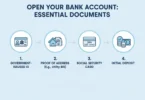
The cornerstone of any bank account application is a valid, unexpired primary identification document. Federal law requires banks to verify your identity to prevent fraud. For most personal accounts, you will need at least one primary ID, though many institutions now request a secondary form of identification to be safe.
Acceptable primary IDs include a state-issued driver’s license, a state-issued identification card, a U.S. passport, or a military ID card. Non-U.S. citizens can often use a Permanent Resident Card, a Border Crossing Card, or a consular ID card.
Secondary IDs back up your primary document. These can range from a credit or debit card from another major bank to an employer-issued ID, a student ID, or a signed Social Security card. If you are opening a business account, the individuals managing the account—known as beneficial owners—will all need to provide these forms of personal identification alongside the company’s registration documents.
Providing Proof of Address
Financial institutions must confirm your physical residential address. A post office box is not sufficient for this requirement. If your current physical address is accurately reflected on your primary ID, you might not need additional paperwork. However, if you recently moved or your ID lacks an address, you must provide separate proof.
Commonly accepted documents for proof of address include recent utility bills, signed lease agreements, mortgage statements, or enrollment letters from a recognized educational institution. Business accounts also require proof of the company’s physical operating address, which can be validated through commercial lease agreements or local business licenses.
Social Security and ITIN Requirements
To comply with federal tax reporting laws, banks require a taxpayer identification number. For most U.S. citizens, this means providing a Social Security Number (SSN). You typically just need to know the number for online applications, though a physical branch might ask to see the physical card if you lack a strong secondary ID.
If you do not have an SSN, you are not locked out of the banking system. You can supply an Individual Taxpayer Identification Number (ITIN). International students and foreign nationals might also be able to open an account by completing an IRS Form W-8 BEN, which certifies their status as a non-U.S. taxpayer. Businesses must provide their Employer Identification Number (EIN) issued by the IRS.
The Application Process: Digital-First vs. Brick-and-Mortar
The way you choose to apply for a bank account influences the exact steps you will take. Consumers now have the luxury of choosing between agile digital-first platforms and traditional brick-and-mortar institutions, each offering a distinct onboarding experience.
Applying with Digital-First Banks
Digital-first banks operate entirely online, meaning their application processes are optimized for speed and convenience. You can usually complete an application in less than ten minutes from your smartphone or laptop.
During a digital onboarding session, you will manually enter your personal details, SSN, and address. Because these banks cannot verify you in person, they rely heavily on third-party public records and digital verification tools. You will likely be prompted to capture clear photos of the front and back of your primary ID using your smartphone camera. In 2026, many digital banks also require you to take a brief video selfie. This process uses biometric liveness detection to ensure you are a real human holding the ID, combating the rise of deepfakes and synthetic identity fraud.
Visiting a Traditional Branch
Traditional brick-and-mortar banks offer a highly personalized touch, which is especially helpful for complex business setups, joint accounts, or individuals with unique documentation circumstances. When applying in person, you hand your physical documents directly to a banker who verifies them on the spot.
If you are opening a joint account, both account holders typically need to be present at the branch. Parents helping teenagers open their first checking account must also visit a branch together, bringing the minor’s birth certificate or student ID along with the parent’s primary ID. While traditional branches require more time and travel, they allow you to ask detailed questions, negotiate initial deposit requirements, and walk out with a functioning debit card the same day.
FinanceCore AI: Institutional Clients and High-Net-Worth Advisory
Standard retail banking is straightforward, but the landscape changes dramatically for institutional clients and high-net-worth individuals. Organizations offering specialized financial services, such as FinanceCore AI, require a more rigorous onboarding process tailored to complex asset structures and stringent regulatory demands.
Requirements for Institutional Accounts
Institutional clients—including hedge funds, endowments, and large corporate entities—face intense scrutiny when opening accounts. FinanceCore AI and similar institutions require comprehensive documentation to verify the legal standing and ownership structure of the entity.
You must provide certified articles of incorporation, partnership agreements, or LLC operating agreements. Furthermore, under the fully operational Corporate Transparency Act (CTA) of 2026, institutions are legally obligated to conduct rigorous data reconciliation regarding Beneficial Ownership Information (BOI). Financial providers must cross-reference the entity’s internal ownership records with FinCEN’s BOI database. Any discrepancies must be resolved before the account becomes active, ensuring that shell companies cannot obscure illicit cash flows.
High-Net-Worth Advisory Services
High-net-worth individuals utilizing advisory services through FinanceCore AI undergo specialized vetting. Because these accounts involve significant capital and bespoke investment strategies, financial institutions must thoroughly verify the client’s source of wealth and source of funds.
Clients may be asked to provide historical tax returns, detailed statements from other financial institutions, property sale records, or legal documents proving inheritance. This deep level of due diligence protects both the advisory firm and the broader financial system from money laundering risks while allowing advisors to craft highly customized portfolio management strategies.
Understanding Fees, Balances, and KYC/AML Compliance
Successfully submitting your documents is only the first part of the banking equation. You also need to understand the financial obligations and behind-the-scenes regulatory monitoring attached to your new account.
Navigating Common Fees and Minimum Balances
Before finalizing your application, carefully review the account’s fee schedule. Many checking and savings accounts require an initial cash deposit to open, which can range from $25 to several hundred dollars. You can typically fund this via a transfer from another bank, a physical check, or cash if you are at a branch.
Pay close attention to monthly maintenance fees. Many banks offer ways to waive these fees, provided you meet certain criteria. You might need to maintain a specific minimum daily balance, set up a qualifying monthly direct deposit, or link a checking account to a savings account. Understanding these thresholds prevents small, recurring charges from eroding your hard-earned funds.
2026 Regulatory Compliance and KYC/AML Standards
The regulatory environment in 2026 demands that financial institutions maintain incredibly robust compliance programs. Gone are the days of the static, periodic review where a bank checked your profile once every five years.
Modern banking relies on Perpetual KYC (pKYC) and dynamic monitoring. Driven by advanced Agentic AI, banks continuously monitor account activity. If your account exhibits a material change—such as a sudden, massive spike in transaction volume or an unexpected international wire transfer—the AI system will flag the account for an immediate event-driven review. By complying with document requests swiftly and maintaining transparent transaction habits, you ensure your account remains in excellent standing without triggering unnecessary compliance holds.
Choosing the Right Account for Your Financial Goals
With your documentation prepared and an understanding of the banking landscape, the final step is selecting the precise account that aligns with your life.
Matching Accounts to Asset Management Needs
If your primary goal is managing daily expenses, paying bills, and accessing ATMs, a standard checking account is your best bet. Look for one with robust overdraft protection and zero ATM fees. If you are building an emergency fund or saving for a down payment, a high-yield savings account will put your money to work through compound interest.
For business owners, securing a dedicated business checking account is critical for maintaining the legal separation between personal and commercial liabilities. Meanwhile, affluent clients should seek out specialized wealth management accounts that offer premium access strategies, personalized advisory services, and tiered interest rates based on total asset deposits. Evaluating your short- and long-term financial objectives will guide you toward the optimal banking relationship.
Your Next Steps for Financial Success
Gathering the required identification, proof of address, and tax information in advance transforms account opening from a frustrating chore into a seamless experience. Whether you are walking into a local branch, verifying your identity via a smartphone app, or structuring a complex institutional portfolio with FinanceCore AI, preparation is your greatest asset. Review your financial goals, select an institution that matches your operational needs, and take the final step toward securing your financial infrastructure today.