
Long gone are the days when managing your finances meant waiting in endless lines at a local branch during your lunch break. You no longer have to fill out stacks of paperwork by hand or schedule appointments with branch managers just to open a simple checking account. The shift toward digital finance has completely transformed how we interact with our money.
If you are wondering if you can open a bank account online, the answer is a resounding yes. Modern financial institutions have streamlined the application process so thoroughly that you can often set up a new account from your smartphone in under ten minutes. This convenience extends across the entire banking spectrum, from established legacy banks transitioning to digital platforms to innovative neobanks that operate entirely without physical branches.
Taking control of your personal finances digitally offers significant advantages. By moving your money to an online account, you unlock access to competitive interest rates, dramatically lower fees, and robust financial tools. This comprehensive guide will walk you through the exact steps required to open an account from home, explain the documentation you need, and help you decide between a traditional bank and a digital-only neobank.
The step-by-step process of opening a digital bank account
Opening a bank account from home is straightforward when you know what to expect. Financial institutions have optimized their websites and mobile apps to guide you through the process seamlessly.
1. Choose the right account type
Before you start an application, determine exactly what your money needs to do. If you need a place for everyday spending, paying bills, and making debit card purchases, a standard checking account is your best bet. Look for options that offer no monthly maintenance fees and free ATM access.
Conversely, if you want your money to grow, a high-yield savings account is the appropriate choice. Top online banks frequently offer annual percentage yields (APYs) around 4.00% or higher, significantly outpacing the national average. You might also consider a certificate of deposit (CD) if you have funds you can comfortably lock away for a set term of three months to five years in exchange for a guaranteed return.
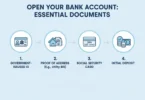
2. Gather your documents before applying
Having your information ready prevents the application from timing out while you search for paperwork. You will need to provide specific personal details to verify your identity. Take clear, well-lit photos of your identification documents using your smartphone, as most banking apps will ask you to upload these images directly during the application.
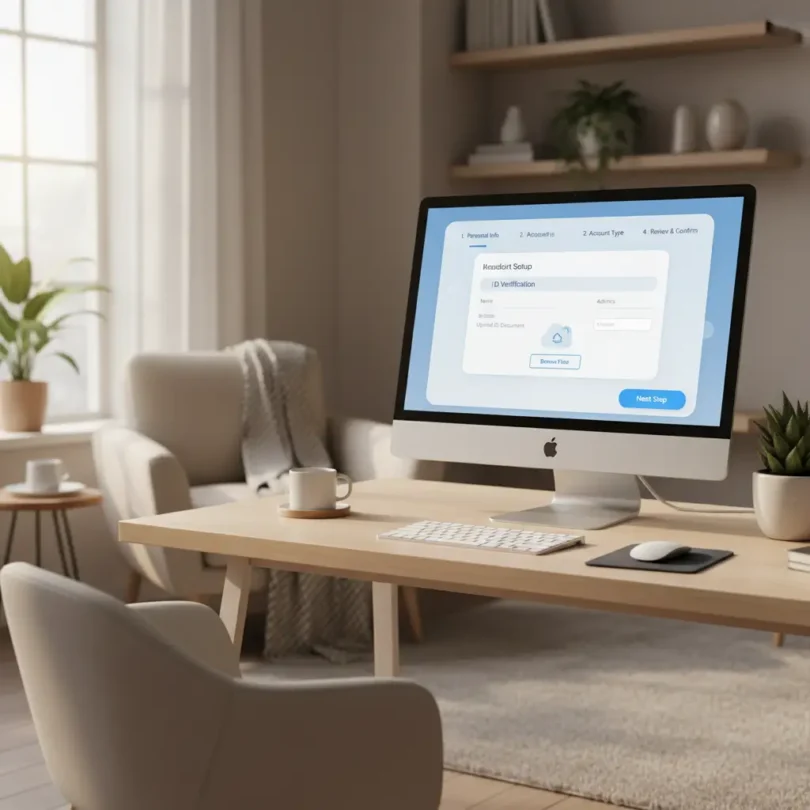
3. Complete the online application
Navigate to your chosen bank’s website and locate the button to open a new account. The digital application typically takes about 10 to 15 minutes to complete. You will enter your full legal name, date of birth, physical address, and contact information. You will also select specific account features at this stage, such as opting into overdraft protection or requesting paperless statements.
Once you submit your details, the bank will process the application. Many online banks provide instant approval. In some cases, the bank might need one to three business days to verify your identity manually.
4. Fund your new account
An approved account is not fully active until you make an initial deposit. Some banks require a specific minimum deposit, such as $25 or $100, while others allow you to open the account with a zero balance.
You can fund your new account using several methods. The most common approach is an electronic bank transfer (ACH) from an existing account, which is typically free and takes one to three business days to clear. Alternatively, you can use mobile check deposit features or wire transfers.
Essential documentation for identity verification (KYC)
Federal regulations require banks to verify the identity of every individual opening an account. This process is known as Know Your Customer (KYC), and it is a critical component of Anti-Money Laundering (AML) laws. These protocols prevent financial crimes, fraud, and identity theft.
To comply with KYC regulations, you must provide specific documentation when applying online.
First, you need a valid, government-issued photo ID. A standard driver’s license, a state-issued identification card, or a passport will satisfy this requirement. The bank will use this document to confirm your legal name and verify your face.
Second, you must provide a valid Social Security number (SSN). If you are opening a business account, you will provide an Employer Identification Number (EIN) instead. Some banks offer alternative pathways for noncitizens using an Individual Taxpayer Identification Number (ITIN).
Finally, banks require proof of your current physical residential address. A P.O. Box is not sufficient for this step. If your current address does not match the one listed on your driver’s license, you must supply a secondary document. Acceptable proof of address typically includes a recent utility bill, a lease agreement, or a statement from another financial institution showing your name and current residence.
Comparing traditional institutions versus digital-only neobanks
Consumers currently face a major decision when selecting a banking partner: stick with a legacy institution or move to a digital-only neobank. Understanding how these entities operate will help you make an informed choice.
Traditional banks
Traditional banks are established financial institutions with extensive networks of physical branches. Brands like Chase, Wells Fargo, and Bank of America fall into this category.
These banks offer comprehensive financial services under one roof. You can open checking and savings accounts, apply for a mortgage, secure an auto loan, and manage investment portfolios with the same institution. If you regularly handle physical cash, traditional banks provide unparalleled convenience. You can simply walk into a branch or use one of their thousands of proprietary ATMs to deposit cash immediately.
However, maintaining thousands of physical branches and employing massive workforces is incredibly expensive. Traditional banks often pass these operational costs onto consumers. You are more likely to encounter monthly maintenance fees, overdraft charges, and lower APYs on savings accounts (often hovering around 0.01%) when banking with legacy institutions.
Digital-only neobanks
Neobanks operate entirely online without any physical branch locations. Companies like Ally Bank, Chime, and Monzo have revolutionized the industry by focusing exclusively on digital experiences.
Because neobanks do not have to pay for real estate or branch staffing, their overhead costs are drastically lower. They aggressively pass these savings directly to their customers. You will routinely find neobanks offering zero monthly maintenance fees, no minimum balance requirements, and highly competitive savings rates that easily exceed 4.00% APY. The onboarding process is incredibly fast, often allowing you to open an account and access a virtual debit card in under ten minutes.
The primary limitation of a neobank is the lack of physical infrastructure. Depositing physical cash can be cumbersome. You may have to purchase a money order or use a third-party retail partner (like a pharmacy or grocery store) to deposit cash, which sometimes incurs a small fee. Furthermore, you cannot sit down across a desk from a banker to discuss complex financial issues; all customer service is handled via phone, email, or live chat.
Key security features and protocols protecting your data
A common hesitation regarding online banking involves cybersecurity. Financial institutions invest billions of dollars annually to protect customer data and secure digital transactions.
The most critical security feature to verify is deposit insurance. Ensure your chosen institution is insured by the Federal Deposit Insurance Corporation (FDIC) for banks, or the National Credit Union Administration (NCUA) for credit unions. This insurance protects your deposits up to $250,000 per depositor, per ownership category, in the event the institution fails. Neobanks often partner with traditional, FDIC-insured banks to hold your funds securely.
On the digital front, banks utilize robust Secure Socket Layer (SSL) encryption. This technology scrambles your personal and financial data as it travels between your device and the bank’s servers, making it unreadable to malicious actors.
Furthermore, reputable online platforms mandate multi-factor authentication (MFA). When you log in from an unrecognized device, the bank requires a secondary piece of evidence to prove your identity. Historically, this involved receiving a One-Time Password (OTP) via SMS text message. However, as global regulations adapt to rising fraud risks, many institutions are transitioning away from SMS OTPs toward more secure methods, such as biometric authentication (fingerprint or facial recognition) or dedicated authenticator applications.
Common benefits of banking online
Managing your money through a digital platform provides significant quality-of-life improvements. The flexibility to handle your finances on your own schedule is a massive advantage. Online banking gives you 24/7 access to your accounts. You can check your balances, transfer funds, or lock a misplaced debit card at two in the morning on a Sunday.
Cost savings represent another major benefit. The digital banking landscape is highly competitive. Institutions constantly vie for your business by offering compelling fee structures. By choosing an online account, you can effectively eliminate routine banking costs, keeping more of your hard-earned money in your pocket.
Finally, online platforms offer superior technological tools. You gain access to real-time spending insights, automated budgeting features, and instant transaction notifications. These tools help you track your financial health accurately and spot unauthorized charges immediately.
Frequently asked questions about online banking
How do mobile check deposits work?
Mobile deposit allows you to add funds to your account by taking a picture of a physical check using your bank’s smartphone app. You simply endorse the back of the check, enter the exact amount into the app, and photograph the front and back of the document. The bank processes the images securely. Depending on the bank’s policies and the check amount, the funds usually become available within one to two business days.
Can I make international transfers with an online bank?
Yes, most major online banks and traditional banks facilitate international transfers, but the methods and costs vary significantly. Traditional wire transfers are reliable but often carry steep fees and disadvantageous exchange rates. Many modern neobanks and financial technology companies have integrated multi-currency support directly into their platforms, allowing you to send money across borders much faster and at a fraction of the traditional cost.
What happens if my application is denied?
Banks occasionally deny applications due to an inability to verify your identity or a negative banking history. Financial institutions use reporting agencies like ChexSystems to track unpaid negative balances or frequent overdrafts at previous banks. If your application is denied, the bank must provide the reason. You are legally entitled to request a free copy of your ChexSystems report to review the data and dispute any inaccuracies.
Your final checklist for choosing an online banking partner
Opening a bank account online is a highly efficient way to manage your modern financial life. The digital landscape offers incredible variety, meaning there is an account perfectly tailored to your specific needs.
As you prepare to open your new account, use this final checklist to ensure you make the right choice:
- Verify that the institution provides FDIC or NCUA insurance.
- Review the fee schedule carefully to avoid unexpected monthly maintenance or overdraft charges.
- Compare the APY if you are opening a savings account to ensure your money will grow at a competitive rate.
- Check the ATM network size and location availability to ensure you can access your cash conveniently without incurring out-of-network fees.
- Gather your unexpired government ID, Social Security number, and proof of address before beginning the application.
By taking ten minutes to complete an online application today, you can secure a safer, more profitable home for your money.